A Colonial Needle Company feature with Shannon & Jason
Let’s get the obvious elephant out of the studio first. A purple school glue stick costs about fifty cents, fits in a pencil pouch, and lives at every drugstore, big box store, and back-to-school endcap on the planet. So when someone at a show tells us they would just grab the cheap stick instead of a Roxanne, we get it. We really do. We use school glue sticks too.
Here’s the part nobody says out loud, though: we use different glues for different work. Not because one is good and the rest are garbage, but because a studio full of textile projects is a lot like a studio full of any other kind of art. You reach for what the job actually needs. Sometimes that’s the fifty-cent tube. Sometimes it very much is not.
Think Like an Artist Buying Supplies
Walk into any art store and nobody blinks when a painter keeps student-grade paper for warming up and saves the good cotton rag for the piece that’s headed to a frame. Pencils, pens, sketchbooks, paints, fabric… they all come in student, artist, and professional grades, and every maker learns to match the material to the moment. Practice needs low-stakes supplies so we don’t freeze up worrying about wasting the fancy stuff. That fear of ruining something precious? It’s a creativity killer, and we refuse to let it win. But the work meant to last for generations needs materials that will actually last for generations.
For some reason, the fiber and textile arts haven’t always insisted on that same distinction. We’ll happily spend real money on gorgeous hand-dyed cotton, precision cutters, and a needle for every occasion… and then reach for an adhesive formulated for third-grade construction paper. So let us walk you through how we actually sort it out on our own worktable.
Three Glues, Three Jobs
School glue sticks
These are our accessibility-and-play tier. They’re what we hand out in beginner-friendly workshops where cost matters and everyone’s just there to learn a technique, and they’re what we grab in the studio when we’re testing a layout or goofing around with an idea. Cheap, washable, everywhere. Perfect for low-stakes, temporary, get-out-of-your-own-head basting.
Permanent glue sticks
These (the UHU-style ones) are our middle tier. When we’re teaching art-forward classes, building mixed media pieces, or doing certain visible mending where we want a bond that stays put, this is the reach. More commitment than school glue, different job than Roxanne.
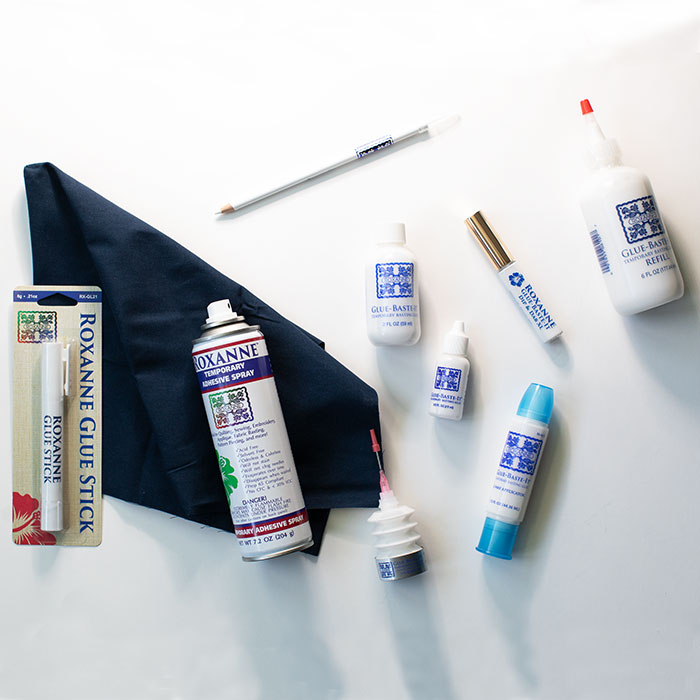
Roxanne Baste-It
This is what we reach for on almost every textile piece that matters here in the studio. Gallery work. Commissions. Heirloom-bound quilts. The pieces we want someone to still be holding in fifty years. It’s the one glue we trust not to gum up our hand stitching or our machine work, it dries flexible instead of crunchy, and it washes out completely and cleanly.
None of that is a knock on the cheaper tubes. It’s just knowing which tool got invited to which party.
What Roxanne Actually Does on Cloth
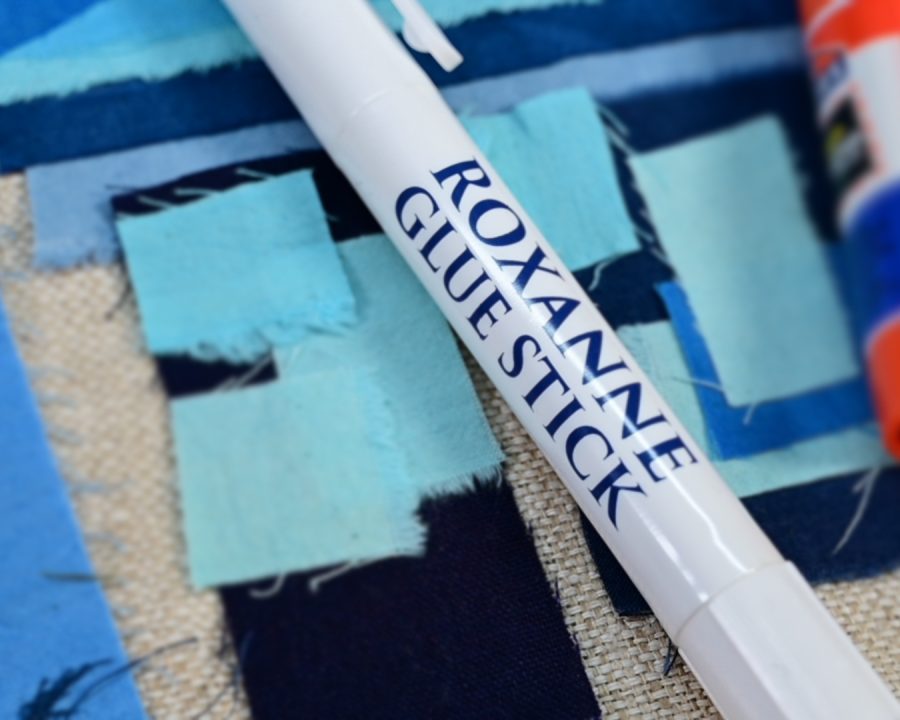
Sticking two things together is easy. Getting fabric to stay put without wrecking its drape, its hand, or its color is the hard part, and that’s where a glue built for textiles instead of paper starts earning its keep.
- Smooth, light application. It doesn’t drag on delicate weaves or leave thick, gummy clumps. For our English paper piecing, we can lay down the finest skiff of it on the template and the fabric, just enough to hold, with none of that sticky mess. On the fine garment fabrics in our upcoming visible mending workshops, that light hand is exactly why it beats a school glue stick, which drags and gums up the very fabrics we’re trying to save (more on the gumming in a minute).
- Fast-drying and water-soluble. It sets quickly so you can keep moving, then washes out completely once the stitching is doing the structural work.
- Made for the actual jobs. Appliqué, bindings, hems, EPP… it holds edges crisp under the genuine physical stress of textile work without turning your piece stiff as a board.
School glue can hold two pieces of cloth together, sure. But Roxanne is the one that was clearly invited to the fabric party.
The Studio View: Saving Your Needles, Your Thread, and Your Sanity
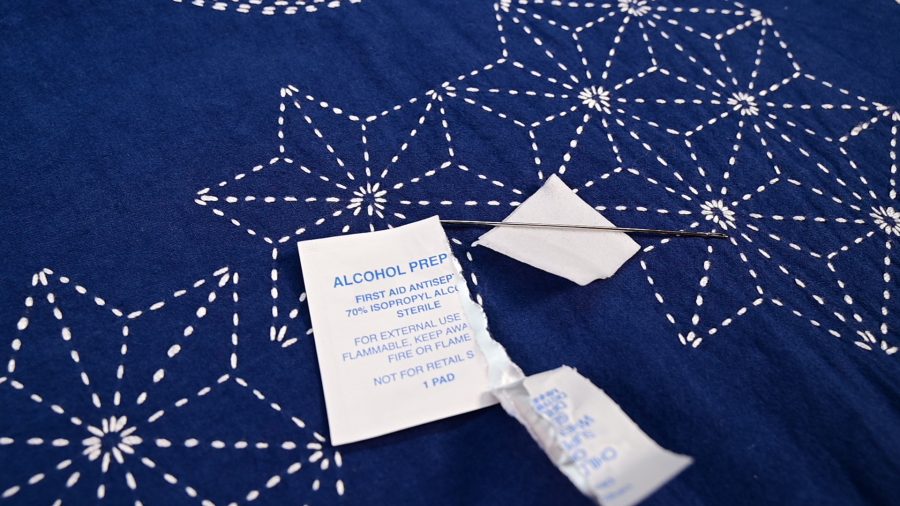
This is the one we feel in our hands, so bear with us while we get specific, because it’s the difference nobody warns you about until you’re living it. When we’re doing the stitching-heavy work we love most, sashiko, visible mending, EPP, appliqué, the wrong glue turns into a genuine problem. The heavier, gummier sticks do hold the fabric in place, we’ll give them that. But they dry stiff; stitching through stiff, gummy fabric is a fight. Worse, the glue transfers onto the needle. By hand, that means a rubbery drag that makes your thimble slide and your hand ache, and it means we’re stopping to wipe our needles down with alcohol to keep them moving smoothly. That’s not a workflow. That’s a chore we invented for ourselves by grabbing the wrong tube.
On the machine it gets worse, and here’s the chain of events we’ve watched happen more than once. The glue gets onto the needle and, with the friction and heat of stitching, melts onto it a bit. Now the needle is tacky, so it grabs at the fabric and pulls it instead of piercing cleanly, and that drag throws off your stitches, sometimes skipping them outright. Then comes the part that really stings: the same gummed-up needle tugging on the thread until the thread itself breaks. We’ve traced more than one snapped length of good thread back to exactly that. None of this is a lab-certified white paper, and we won’t dress it up as one. It’s our studio experience, learned the annoying way. But it’s consistent enough that we trust it.
Roxanne dries down light and flexible, so whether the needle’s driven by your hand or your motor, it slips through the basted zone instead of collecting adhesive and dragging it into the works. No alcohol wipes, no melting, no mystery thread breaks. Just smooth, rhythmic stitching, which is the whole reason we sat down to sew in the first place.
The Preservation Angle: Why Old Quilts Go Brown
Here’s the one that keeps us honest, because we’ve handled a lot of vintage textiles and old quilts, and we’ve seen the damage up close. You know those brown and yellow stains that bloom on antique pieces over the years? Most of us recognize them on sight. Fewer of us stop to ask what actually causes them.
A big part of the answer is the adhesives. Many old glues were acidic to begin with, or turned acidic as they aged and broke down, and that acid migrates straight into the fibers. Acid is what makes natural fabric yellow, weaken, and eventually fall apart, the same reason conservators fuss over acid-free mat board and archival tissue. Some adhesives off-gas as they degrade too, which doesn’t help. The through-line is simple: put an acidic, breaking-down glue against cloth and give it enough time, and the cloth pays for it.
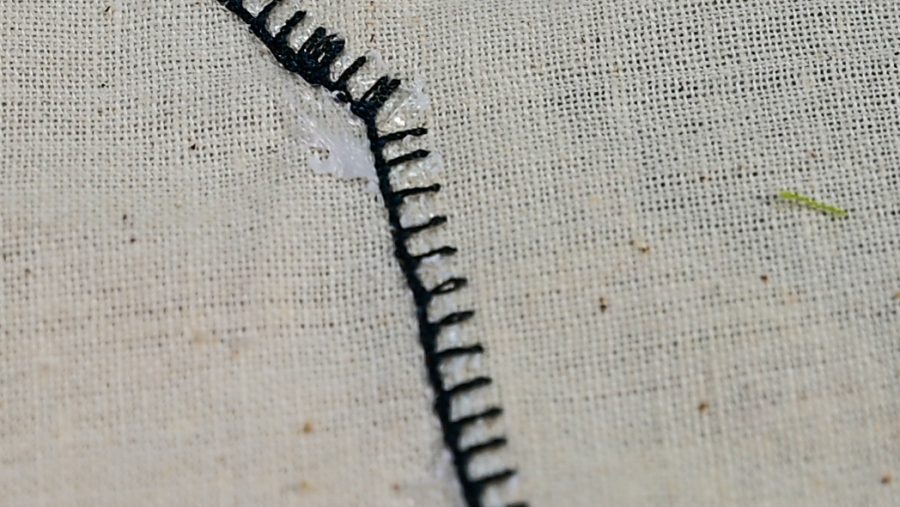
Which is exactly why acid-free and pH-neutral aren’t just label decoration. An acid-free adhesive isn’t leaving a slow decay bomb tucked inside your quilt sandwich or your garment seams. Roxanne is acid-free and pH-neutral, and that’s the language we’re comfortable standing behind. You’ll hear folx toss around archival too, but in textile conservation that word carries the weight of decades of standardized testing, so we’d rather keep our claims clean and true: acid-free, pH-neutral, and a safe, stable choice when you want today’s work to still be here for the folx who come after you.
Use the Right Tool for the Job
Cheap glue sticks have their place, and we mean that. Mockups, rough drafts, kid projects, quick low-stakes fixes, and every I’m-just-playing moment where the whole point is not to feel precious about it. Keep that fifty-cent tube. Use it with joy.
But when you move past practice and into the work that matters, your tools should match your effort. Not every project deserves the fancy glue. But when the fabric matters, the fancy glue isn’t actually fancy. It’s just the better tool. Roxanne is the one we reach for when we want fabric to behave: smooth application, a lighter hand, easier stitching, and zero drama at the needle. That’s the whole philosophy, really. There’s a right tool and a right material for every project, and the trick is just knowing which is which.
Stitch on,
Shannon & Jason
🧵 Shop Roxanne Baste-It Glue and the full Roxanne glue lineup here.
📌 Explore Colonial Needle’s needles, thimbles, and notions for your next textile project here.
▶️ Catch more Colonial Needle tips and tutorials on YouTube here.