Bullion Knot: The Twisted Rose Stitch That Adds Beautiful Texture

If January was about invisible mending, February is about texture, dimension, and a little romance.
The Bullion Knot is a wrapped stitch that creates raised coils of thread — often used to form roses, flower buds, wheat sheaves, and dimensional embellishments. It’s decorative, elegant, and surprisingly versatile once you get the rhythm.
What Is a Bullion Knot?
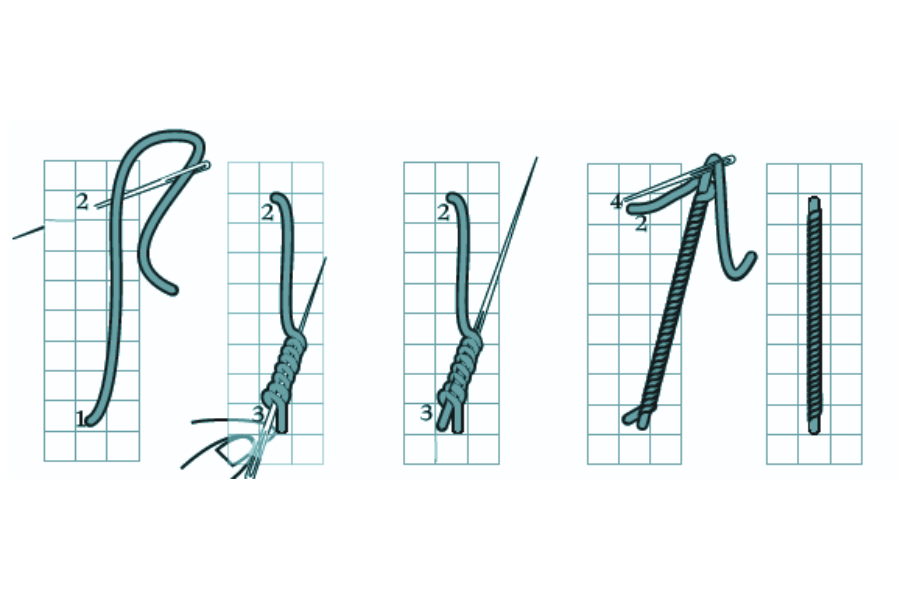
A bullion knot is made by wrapping thread multiple times around your needle before pulling it through the fabric. The wraps form a smooth, raised coil that sits on top of the fabric.
Think of it as a longer, sleeker cousin of the French knot.
When & How It’s Used
Bullion knots shine in:
• Floral embroidery (roses, lavender, buds)
• Vintage linens
• Heirloom sewing
• Crazy quilting
• Dimensional embellishment
• Monograms with texture
They’re especially popular in spring projects — but work beautifully year-round for adding interest and depth.
What You’ll Need
• Embroidery needle (milliners/straw needles work best)
• Embroidery floss or perle cotton
• Fabric in a hoop
• Small scissors
Pro Tip: Milliners needles are ideal because the shaft and eye are the same width — which makes sliding wraps much easier.
How to Make a Bullion Knot
- Bring needle up through fabric.
- Insert needle back down a short distance away — but don’t pull it through.
- Wrap thread around the needle 6–12 times (depending on desired length).
- Hold wraps firmly with your thumb.
- Gently pull needle through wraps.
- Lay coil smoothly against fabric and pull snug.
If it twists — don’t panic. Slow tension and steady hands are the key.
Why We Love It
Bullion knots instantly elevate simple designs. A cluster of them becomes a rose. A row becomes textured trim. A single one can anchor a delicate motif.
It’s the perfect stitch to practice patience — and it rewards you with dimension you just can’t get from flat stitches.